Edging is one of the most overlooked parts of a driveway, right up until it’s missing. It’s the difference between a clean, defined drive that holds its shape for decades and one where loose gravel keeps creeping onto the lawn, or block paving starts to spread and rock underfoot within a couple of years.
If you’re weighing up ideas for edging a driveway, whether you’re planning a full resurface or just want to smarten up what’s already there, the options range from a few pounds a metre in treated timber to premium natural stone that can outlast the driveway itself. The right choice depends on your budget, your house’s style, and how much upkeep you’re willing to take on.
This guide runs through ten proven driveway edging ideas, what each one costs, and which properties they suit best. We’ll also cover driveway edging kerbs specifically, since kerbing and border edging aren’t quite the same thing and get confused often.
Whether you’re after a budget-friendly weekend fix or a premium finish to match a full block paving driveway, there’s an option here that fits.
What Is Driveway Edging and Why Does It Matter?
Driveway edging is the border that runs along the perimeter of a driveway, separating it from the lawn, flower beds, or pavement. It sounds like a finishing touch, but it does real structural work.
Without a solid edge, loose materials like gravel or block paving have nothing to push against. Vehicle weight and weather gradually force the surface outward at the sides, which is how driveways end up wider, uneven, and messier than the day they were laid. Edging locks the surface in place and keeps the line between drive and garden sharp.
It also affects drainage. UK driveways installed since 2008 are required to either use a permeable surface or direct rainwater back onto the property rather than into the public drain, and the type of edging you choose can support or work against that. A raised concrete kerb, for example, can trap water on a permeable gravel or resin surface if it isn’t installed with the right falls, which is worth discussing with whoever installs it.
Beyond its functional role, edging is one of the cheapest ways to enhance a driveway’s overall appearance. A tidy, well-defined border reads as “well-maintained” from the moment someone pulls up, even if the driveway surface itself is a few years old.
10 Driveway Edging Ideas To Improve Kerb Appeal
1. Block Paving Border
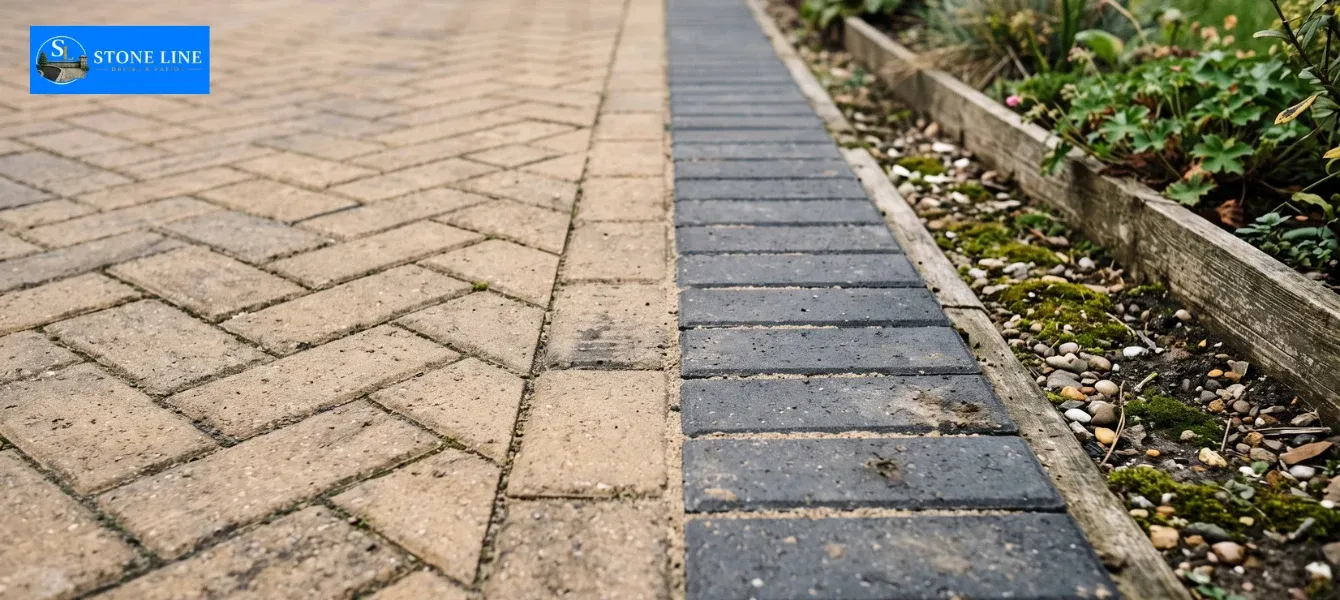
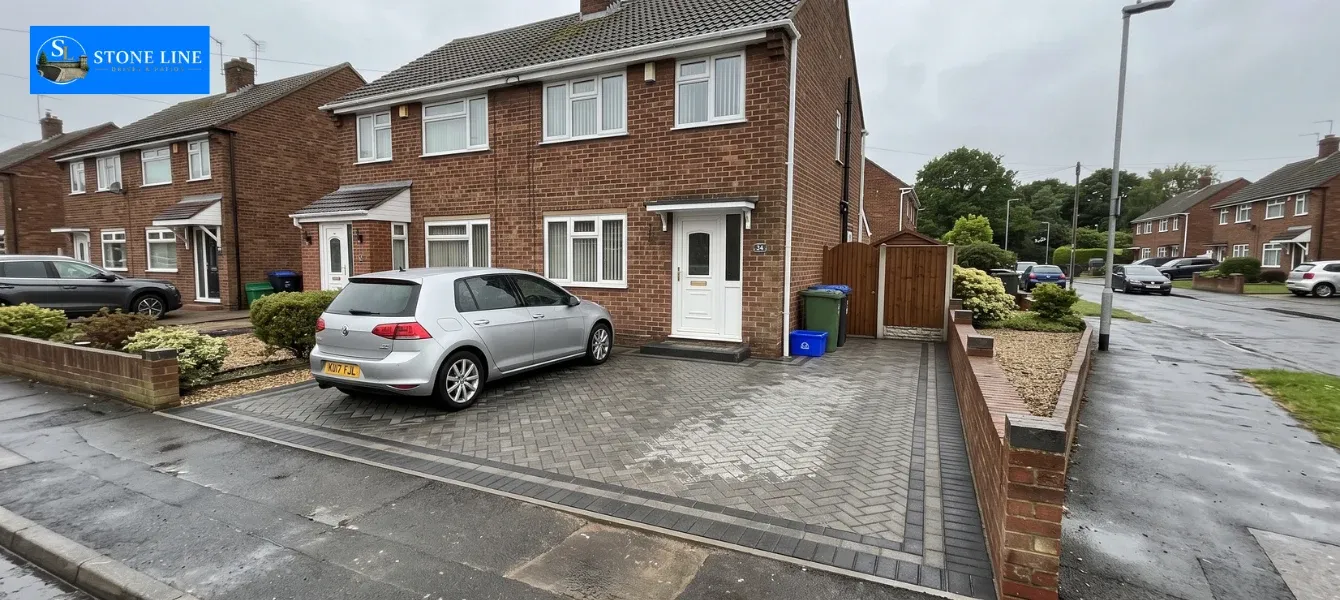
A block-paving border uses a contrasting course of blocks, usually one or two rows, laid around the perimeter of the main driveway. It’s the standard finish on most modern block paved driveways in Ashford and across Kent, and for good reason: it ties in with the main surface rather than looking like an add-on.
Borders are typically laid in a darker or lighter shade than the field blocks to create definition, sometimes with a soldier course (blocks laid end-to-end rather than side-by-side) for a crisper line. Because the border is bedded and compacted the same way as the rest of the drive, it holds its shape well and can be repaired block by block if one gets damaged.
Best for:
Block paving driveways, period and modern homes alike, anyone wanting the edging to look like part of the original design rather than an addition.
2. Stone Driveway Edging
Natural stone edging, whether granite setts, sandstone kerbs, or reclaimed stone, gives a driveway a premium, timeless finish that suits older or characterful properties particularly well. Stone doesn’t fade, rot, or need repainting, and it develops a weathered look over time that most homeowners see as an asset rather than a downside.
The trade-off is cost and installation time. Natural stone is heavier and less uniform than manufactured alternatives, so it takes longer to lay properly and costs more per metre. It’s usually chosen when the driveway itself is made of a premium material, such as natural stone paving or high-end resin-bound surfacing, so the edging matches the overall standard of the job.
Best for:
Period properties, natural stone or premium resin driveways, homeowners prioritising longevity over upfront cost.
3. Gravel Driveway Edging
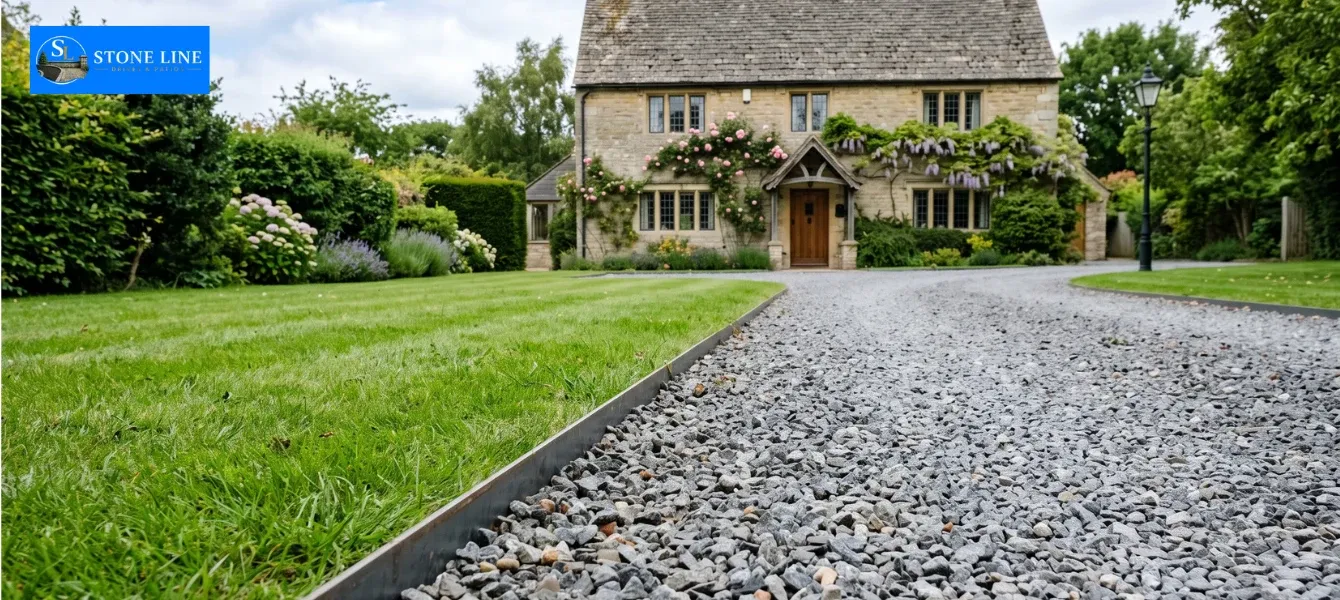
If your driveway surface is gravel, the edging isn’t optional; without it, gravel migrates onto the lawn, the pavement, and eventually the road within a single winter. Gravel driveway edging usually takes the form of a retaining border, which can be steel, timber, a concrete kerb, or even sunken brick, installed slightly proud of the gravel to hold it in place.
Gravel is one of the most affordable driveway surfaces available, and pairing it with a simple retaining edge keeps the overall project cost low while still giving a clearly defined finish. It’s also naturally permeable, which helps with drainage compliance, provided the edging doesn’t create a barrier that traps standing water.
Best for:
Gravel and shingle driveways, rural or cottage-style properties, budget-conscious permeable driveway projects.
4. Brick Driveway Edging
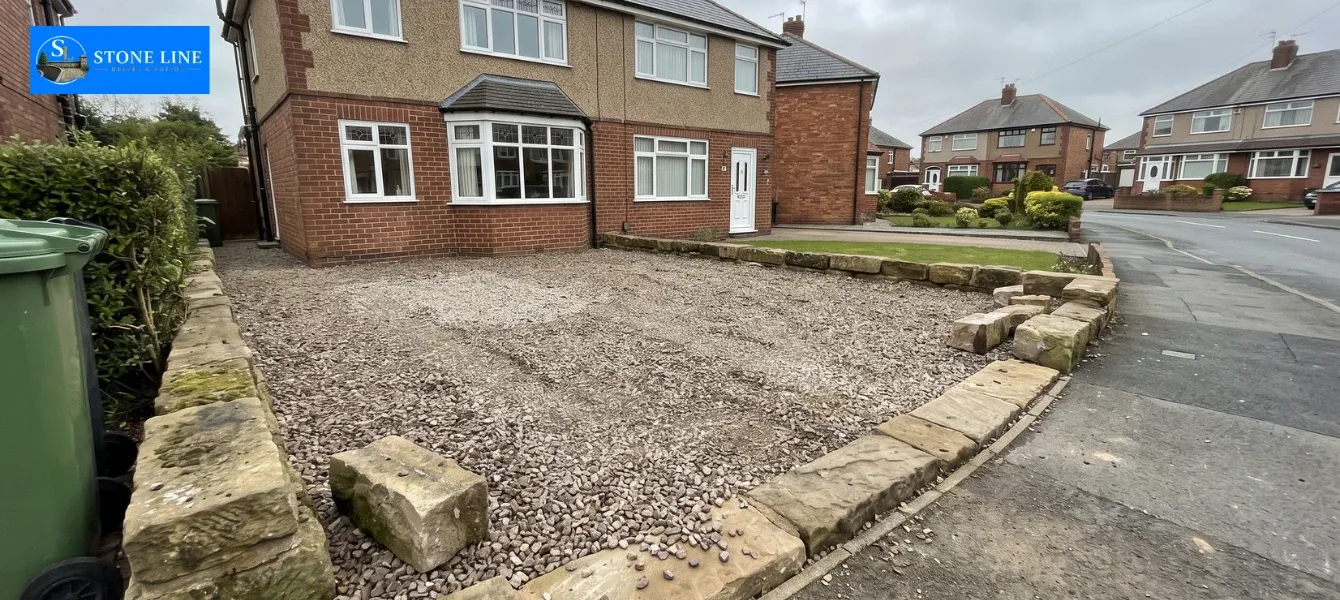
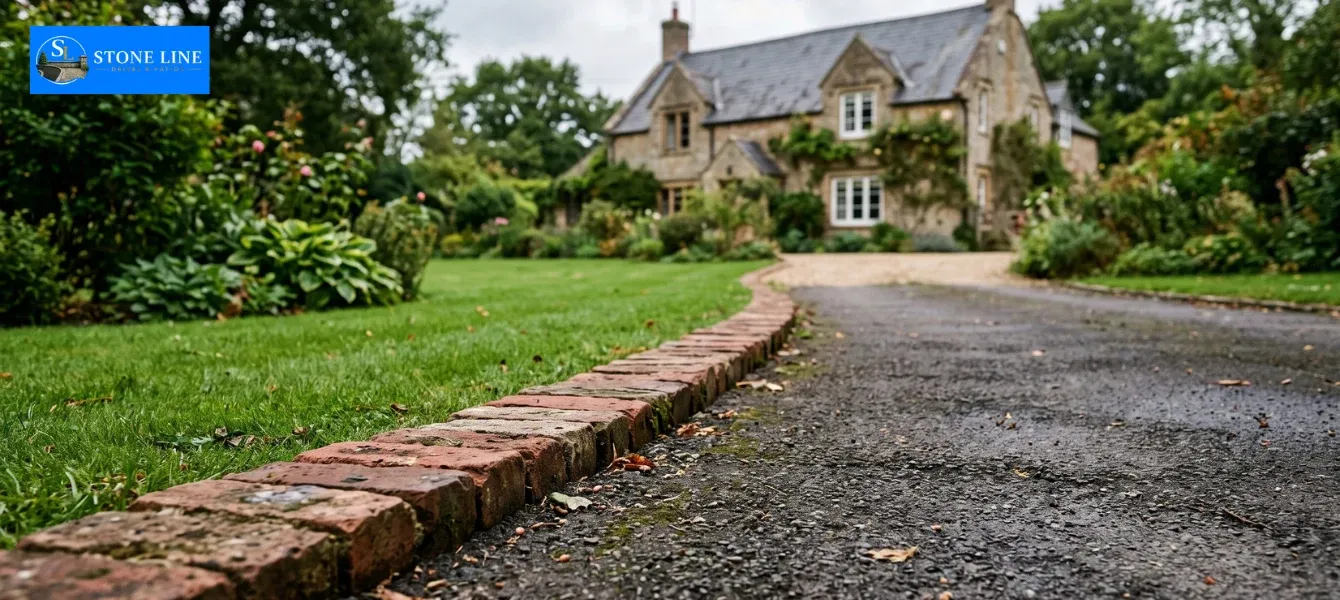
Brick edging is one of the most popular choices for driveways in the UK, largely because it strikes a good balance between cost, durability, and traditional appeal. Bricks can be laid end-to-end for a subtler line or side-by-side (sometimes called a soldier course) for a bolder, more visible border.
According to Checkatrade’s cost data, brick edging typically costs around £30 per metre laid end-to-end, rising to roughly £75 per metre for a side-by-side arrangement, depending on the brick type and labour rates in your area. It works particularly well alongside brick or block paved driveways, tarmac, and resin surfaces where a warmer, more traditional border is desired.
Best for:
Traditional and period homes, tarmac or resin driveways that need a defined edge, and mid-range budgets.
5. Concrete and Cement Driveway Edging
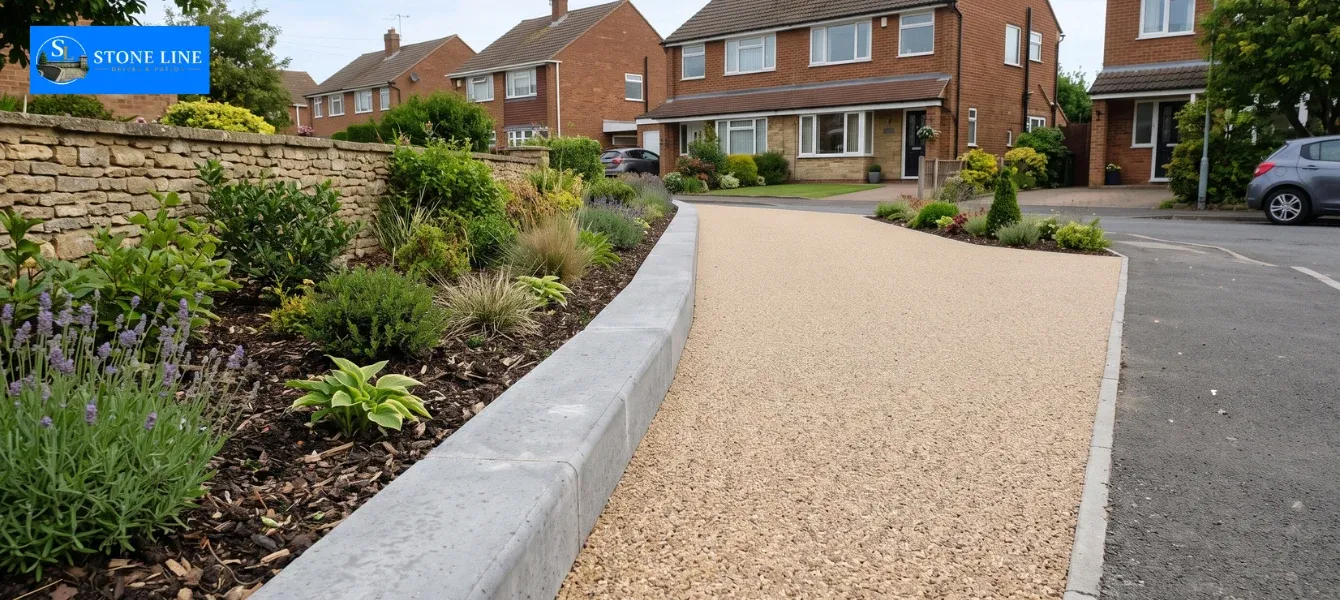
Concrete driveway edging (sometimes searched as cement driveway edging, though the terms usually mean the same finished product) comes in two main forms: pre-formed concrete kerb units, which are manufactured off-site and simply bedded into place, and poured or continuous concrete, which is cast on-site into a mould running the length of the drive.
Pre-formed concrete is the cheaper and quicker option, with Checkatrade putting the average cost at around £25 per metre for materials and labour. Poured concrete costs more, averaging closer to £55 per metre, but gives a completely seamless, joint-free line, which suits long, straight driveways especially well. Concrete is low-maintenance and extremely durable, making it one of the most practical choices for tarmac and resin driveways where budget matters more than decorative detail.
Best for:
Tarmac and resin driveways, straight driveway runs, homeowners wanting a durable, low-maintenance edge without a high price tag.
6. Metal Driveway Edging
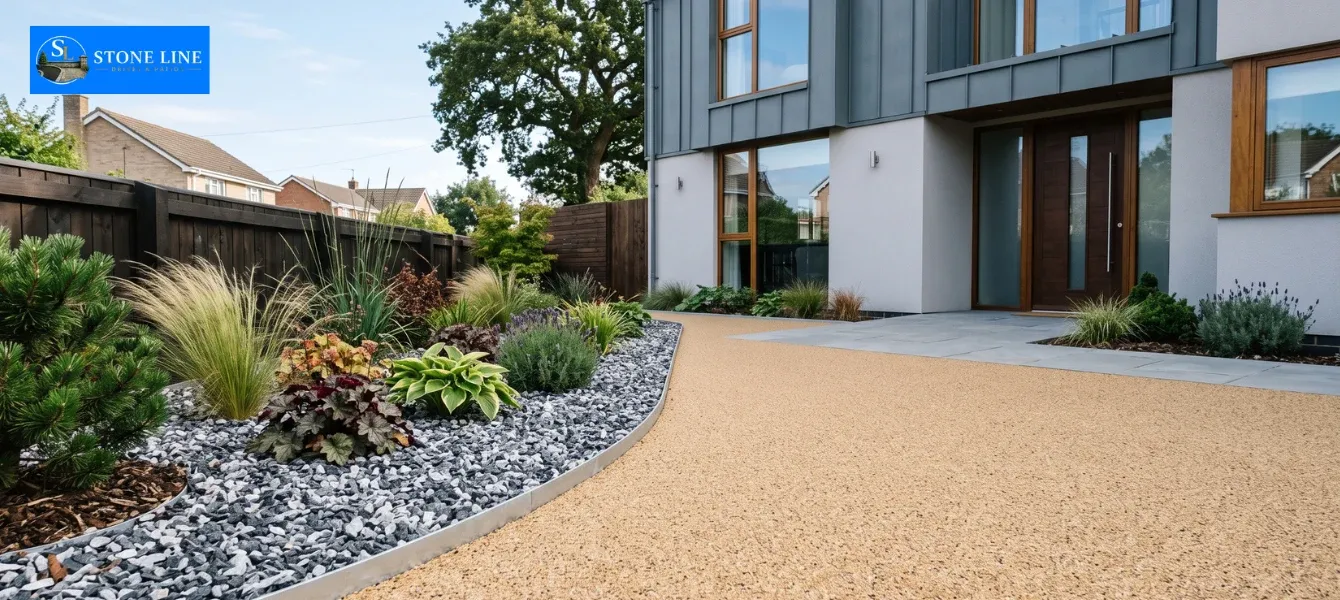
Metal edging, usually galvanised steel or aluminium strip, has become a popular choice for contemporary driveways, particularly where resin-bound or gravel surfaces meet a lawn or planting bed. It creates a slim, almost invisible line rather than a chunky border, which suits modern, minimalist garden designs.
It’s a premium option: Checkatrade data puts the average cost of metal edging at around £75 per metre, reflecting both the material and the more specialist fitting involved. Steel needs to be properly treated, or it will rust over time, so it’s worth confirming with your installer what coating or grade is being used before committing.
Best for:
Modern resin or gravel driveways, contemporary garden design, homeowners wanting a discreet rather than decorative border.
7. Timber Driveway Edging
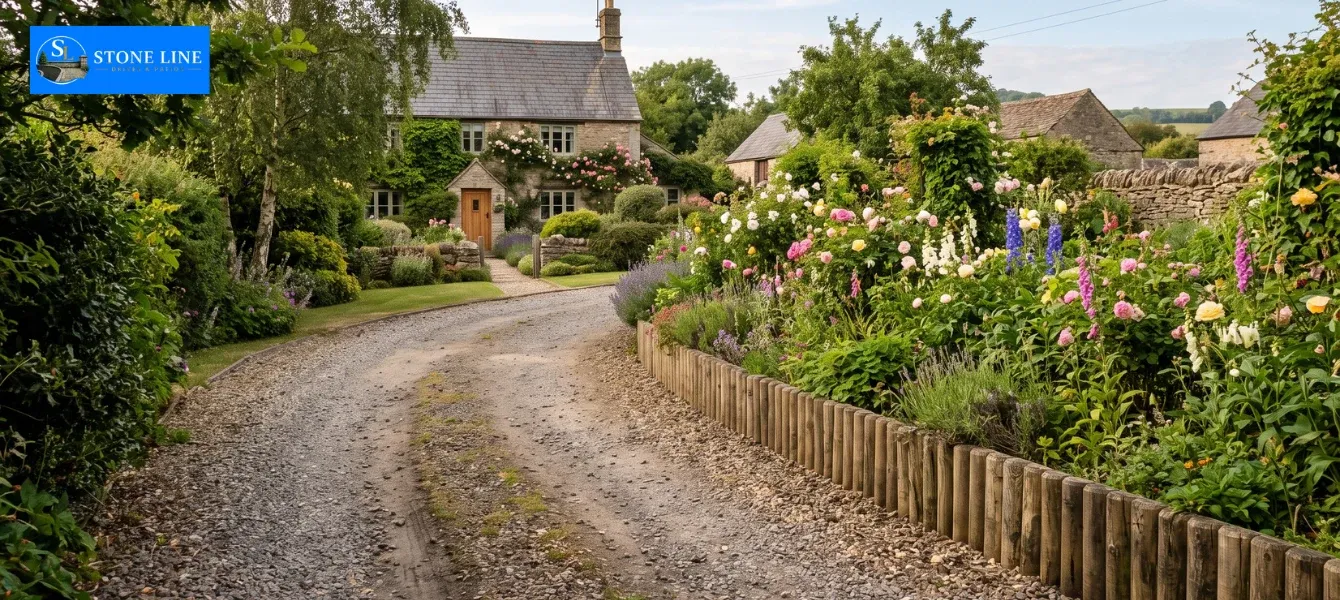
Timber edging is one of the most affordable ways to define a driveway, whether as simple gravel boards, log roll, or sawn timber sleepers. It suits cottage gardens, rural properties, and gravel driveways particularly well, giving a soft, natural finish that blends into planted borders.
Cost is the main appeal here, with Checkatrade quoting an average price of £6.50 per metre for timber edging, considerably cheaper than brick, stone, or metal edging. The downside is maintenance: untreated timber will rot within a few years. Hence, it needs a proper wood treatment or pressure-treated timber from the outset, with periodic re-treatment thereafter.
Best for:
Gravel driveways, cottage or rural properties, tight budgets where some ongoing maintenance is acceptable.
8. Tarmac Driveway Edging
Where the driveway surface itself is tarmac, many homeowners simply extend the tarmac slightly proud at the edges to create a rolled lip, rather than introducing a separate edging material. It’s the most cost-effective option because no additional materials or trades are needed; it’s finished as part of the main surfacing job.
The limitation is that tarmac edging offers less visual definition than block, brick, or stone borders, and a plain tarmac edge can look unfinished on driveways where kerb appeal is a priority. It’s most commonly paired with a hard kerb or block-paving border along the front edge (where the driveway meets the pavement), while the side boundaries are left as a simple tarmac roll.
Best for:
Larger or commercial tarmac driveways, practical budgets, properties where the front boundary already has kerbing.
9. Raised Edging
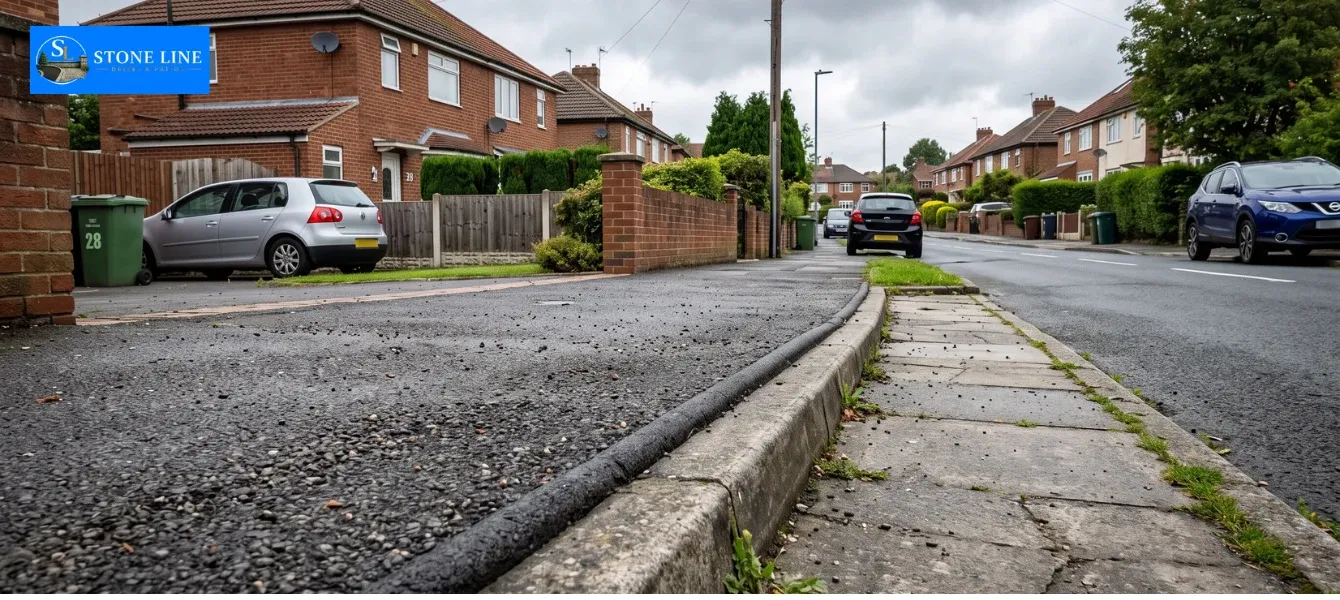
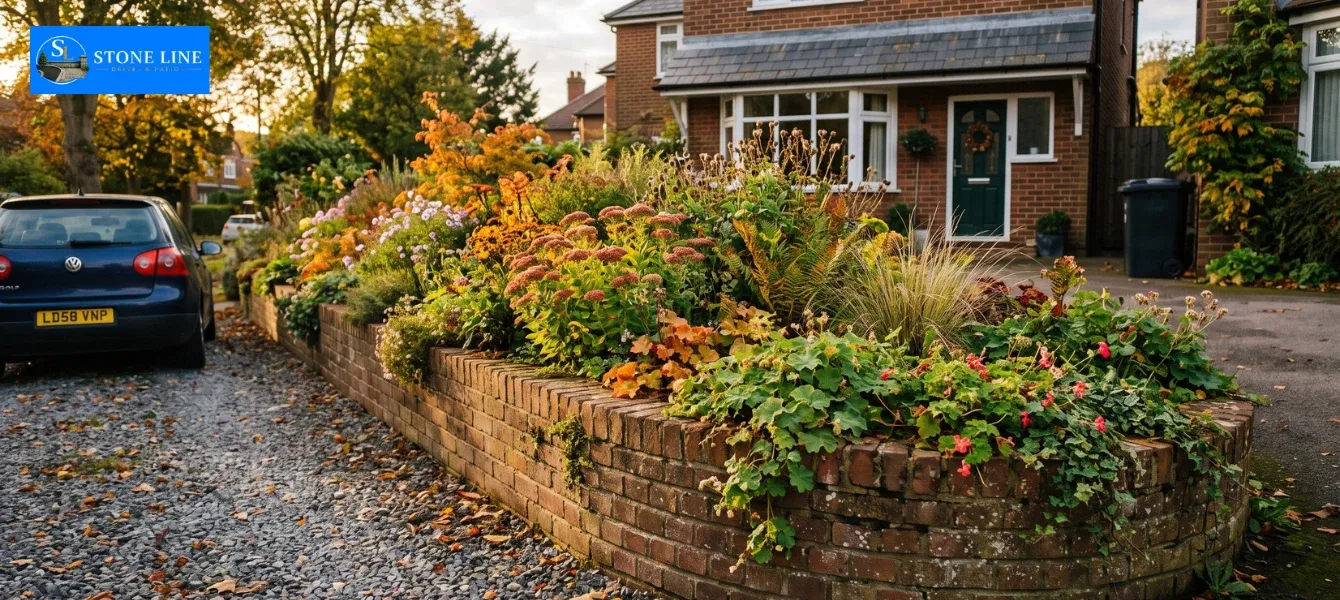
Raised edging sits proud of the driveway surface rather than being flush with it, and is typically used where a driveway borders a flower bed, sloped garden, or lawn at a different level. As well as looking neater, a raised edge acts as a small retaining wall, stopping soil, mulch, or lawn from washing onto the driveway surface after rain.
It can be built from brick, concrete block, sleepers, or stone, so the material choice tends to match the surface or garden style used elsewhere on the property. Height is worth getting right: too low and it won’t retain soil effectively, too high and it becomes a trip hazard or awkward step.
Best for:
Driveways bordering raised flower beds or sloped gardens, properties wanting a clearer visual separation between hard and soft landscaping.
10. Cheap Driveway Edging Ideas
If budget is the main driver, there are still ways to get a defined, tidy edge without a big spend. The most affordable options are:
- Log roll or basic timber edging – from around £6.50 per metre, ideal for gravel drives
- Pre-formed concrete kerb units – from around £25 per metre, a durable option for tarmac or resin edges
- Recycled or reclaimed brick – often cheaper than new brick if a local supplier or reclamation yard has stock
- Simple gravel boards – a budget-friendly retaining option for gravel or shingle surfaces
The cheapest route is usually to match the edging to what’s already in place rather than introducing a new material; for example, using leftover blocks from the main driveway as a border rather than sourcing stone or metal separately. It’s worth asking your contractor whether offcuts from the main job can be reused this way before buying anything new.
Driveway Edging Kerbs: What Are Your Options?
Driveway edging kerbs are worth covering separately, because “kerb” specifically refers to a raised, pre-formed unit (usually concrete, granite, or block) rather than the general category of border materials covered above. Kerbing sits at the boundary of the driveway and is typically what’s used at the front, where the drive meets the pavement or road.
Common driveway edging kerb options include:
- Precast concrete kerb units
The standard, cost-effective choice used on most residential driveways
- Granite setts
A premium, long-lasting kerb option often used on higher-end properties
- Block paving kerb units
Manufactured to match the block paving range, giving a seamless look with the main surface
One important distinction: kerb edging for driveways is not the same as a dropped kerb. A dropped kerb is the lowered section of a public pavement kerb that allows vehicle access from the road onto a private driveway, and it requires a separate application to the local council (Kent County Council for Stoneline’s service area) and a fee. Edging kerbs along the sides of the driveway do not require planning permission or council approval in most cases, since they sit entirely on private property. If you’re unsure which applies to your project, this is exactly the kind of question a local paving company in Ashford can answer quickly, so it’s worth checking before ordering materials rather than after.
Driveway Edging Cost Comparison
| Edging Material | Approx. Cost Per Metre | Best Suited To |
|---|---|---|
| Timber (log roll/gravel board) | £6.50 | Gravel driveways, rural properties |
| Pre-formed concrete kerb | £25 | Tarmac, resin, budget-conscious projects |
| Block paving border | £25–£40 | Block paving driveways |
| Brick (end-to-end) | £30 | Traditional homes, tarmac/resin edges |
| Brick (side-by-side) | £75 | Higher-visibility traditional borders |
| Poured/continuous concrete | £55 | Long, straight driveway runs |
| Metal (steel/aluminium) | £75 | Modern resin or gravel driveways |
| Natural stone | Varies, premium | Period or high-end properties |
* Prices vary depending on material grade, driveway length, and ground preparation required. Always request a written, itemised quote before committing to any driveway project.
How to Choose the Right Driveway Edging for Your Property
With so many ideas for edging a driveway to choose from, it helps to work through a few practical questions before deciding:
What’s the main driveway surface?
Gravel and resin need a retaining edge to function properly; tarmac and block paving are more flexible in style since the edging is largely decorative.
What’s your budget?
Timber and pre-formed concrete sit at the affordable end; natural stone and metal sit at the premium end.
How much maintenance are you willing to do?
Timber needs periodic treatment; stone, concrete, and block paving need virtually none.
Does it need to match existing materials?
A border that ties into the driveway surface or the brickwork of the house will always look more considered than one that’s visually unrelated.
Is drainage a factor?
If your driveway relies on permeability to meet planning rules, check that any raised edging won’t trap surface water.
If you’re not sure which combination makes sense for your property, this is exactly the kind of thing worth discussing on-site rather than guessing from photos online, since ground levels, existing boundaries, and the surface material all affect which options are realistic. Our paving and landscaping services in Ashford cover exactly this kind of assessment as standard, at no extra cost.
Why Choose Stoneline Drives and Patios for Driveway Edging in Ashford and Kent
At Stoneline Drives and Patios, we fit edging as standard on every block paving, tarmac, and resin driveway we install, and we’re just as happy to add or replace edging on an existing driveway that needs tidying up.
We carry out all groundwork ourselves- no subcontractors- so the edging is bedded and compacted to the same standard as the rest of the drive rather than treated as an afterthought. If your project also involves borders around beds or paths, our landscaping and garden walling teams can handle that as part of the same job.
We’re based in Ashford and work across Kent, including Kennington, Willesborough, Folkestone, and Maidstone, and every quote is written, itemised, and free with no obligation to go ahead.
Conclusion
Good driveway edging does two jobs at once: it stops the surface spreading or washing away, and it’s one of the simplest ways to sharpen up how a driveway looks from the street. Whether that means a timber gravel board on a budget, a brick border on a traditional block paved drive, or granite kerbs on a premium natural stone finish, the right choice comes down to your driveway’s surface, your budget, and how much upkeep you want going forward.
If you’d like advice on the best edging for your driveway in Ashford or anywhere across Kent, contact Stoneline Drives and Patios today for a free, no-obligation quote. We’ll visit your property, talk through the options that suit your surface and budget, and give you a clear written price with nothing hidden.
FAQ’s
What is the cheapest driveway edging option?
Timber edging, such as log roll or gravel boards, is the cheapest option at around £6.50 per metre, making it a popular choice for budget gravel driveways. Pre-formed concrete kerb units are the next most affordable, at around £25 per metre, and suit tarmac or resin driveways that need a longer-lasting edge.
Do I need planning permission for driveway edging?
No, edging along the sides of a driveway on private property usually does not require planning permission. This is different from a dropped kerb, which allows vehicle access from the road and does require a separate application to your local council.
What's the best driveway edging for a gravel driveway?
Gravel driveways need a retaining edge to stop the stones from spreading onto the lawn or pavement. Steel, timber, or pre-formed concrete kerbs all work well, with the choice usually coming down to budget and how visible you want the border to be.
Can I match driveway edging to my existing block paving?
Yes. Most block paving manufacturers produce matching kerb and border units in the same range, which is the most common way to edge a block-paved driveway, as it keeps the colour and finish consistent with the main surface.